
Empathy Skill-Building Toolkit
Erasmus+ KA220-SCH · Project no. 2024-1-MK01-KA220-SCH-000257909 · Co-funded by the European Union
Empathy in the Digital Age: Harnessing Technology for Understanding and Connection (DigiEmpathy) is coordinated by the Institute for Applied Research for Business and brings together partners from five countries — North Macedonia, Greece, Türkiye, Portugal and the Czech Republic — to strengthen empathy as a key competence in education, for students aged 8 to 16.
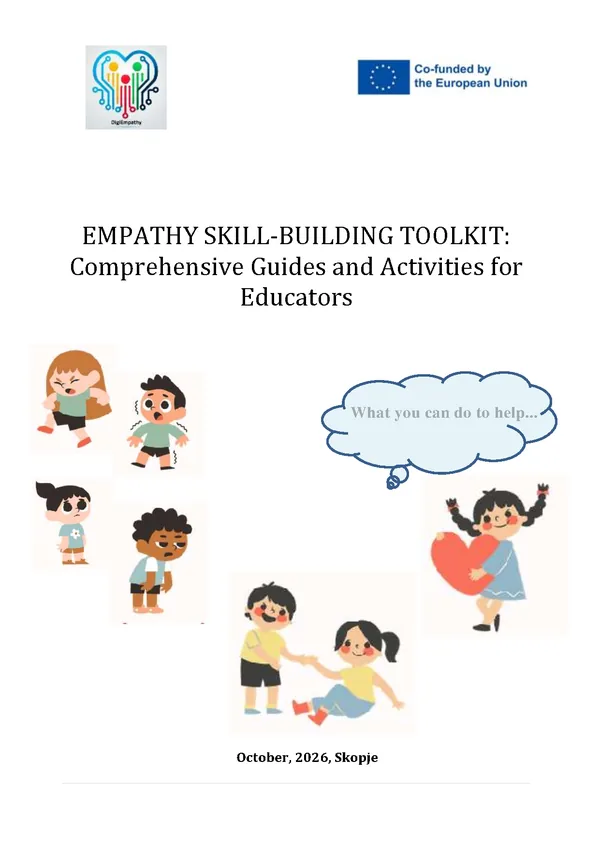
The Empathy Skill-Building Toolkit (October 2026, 130 pages) is a structured combination of theoretical foundations, reflective approaches and ready-to-use classroom activities covering:
- Empathy, self-awareness and emotional identification;
- Empathetic leadership and leadership styles;
- Empathic communication and active listening;
- Coping strategies and empathic conflict management;
- Biases, diversity and the impact of empathy on well-being, productivity and innovation.
Download the toolkit
Empathy Skill-Building Toolkit (English)Published by the Institute for Applied Research for Business, Ul. Železnička 38/1-5, Skopje. Licensed under Creative Commons (CC BY-NC 4.0) — may be used, copied and shared for non-commercial purposes provided the origin is credited.
What the toolkit covers
- Empathy, Self-Awareness and Emotional Identification
- Empathetic Leadership and Leadership Styles
- Empathic Communication and Active Listening
- Coping Strategies and Empathic Conflict Management
- Biases, Diversity and the Impact of Empathy on Results
Authors & editors — Empathy Skill-Building Toolkit
For the publisher: Prof. Dr. Biljana Gjozinska, Director. Editorial and design: Prof. Dr. Aneta Vasiljevikj-Shikaleska. Reviewers: MSc Dragana Veljanoska and Vesna Blazevska.
Authors from the Institute for Applied Research for Business: Aneta Vasiljevikj-Shikaleska, Biljana Gjozinska and Adrijana Bulevska Zarikj, together with partner authors Fotios Kolokotronis, Leonidas Chalkiadakis, Emmanouil Beladakis, Evgenia Psaltaki (Institute of Humanities and Social Sciences, Greece), Murat Yazçiçek, Fikret Yaman, Ayşe Altay, Vildan Uluca (Kizilcahamam Anadolu Lisesi, Türkiye), Kenan Arslan, Nurdan Kahveci, Aslı Cüre (Samsun İl Millî Eğitim Müdürlüğü, Türkiye), Maria Amélia Veloso, Ana Paula Reis, Adriana Resende, Juliana Pinto (Aplicaproposta Lda, Portugal), and Nina Ščerbová, Anna Šlichtová, Jan Malata (SZŠ a VOŠZ Plzeň, Czech Republic).
Empathy Empowerment Guide
A companion publication from the same project: strategies and best practices for educators on empowering empathy in school education, integrating technology to enhance empathy skills, and monitoring the empathy-empowerment process — plus five of the project's most impactful practices from the field.
Download the guide
English edition (ISBN 978-608-67060-3-6)Macedonian edition / Македонско издание (ISBN 978-608-67060-7-4)